 User Help Manual
  Learn FAQ
  Send us feedback


Video Editor
Download and use the free video software to create and edit videos of any complexity from a family greeting card to a company presentation. Apply vsdc free video editor for light edit hdr-video, any raw-video formats from cams - BRAW, ProRes RAW, any high resolution 4k or more due to video proxies technologies in the editor.
Cut, merge video files, apply visual and audio effects, use filtration and image correction, make slideshows and add an appropriate soundtrack. Use multi-color Chroma Key and advanced parameters settings to give your video a professional look.
All popular video and audio formats are supported.
Video Converter
This program is intended for converting video files from one format to another. Nearly all popular video formats are supported (both reading and saving). In addition, the program drastically simplifies the task of converting videos for playback on specific multimedia devices, such as iPhone, Samsung Galaxy or Huawei P30 Pro. The program is extremely easy to use, has a modern interface and all necessary video processing functions.
Audio Converter
The audio converter will help you convert audio files from one format to another. All key audio formats and codecs are supported. The program also allows you to manage playlists and meta tags, extract audio from video files and save these tracks on your computer in any format.
Animated Intro & Title Templates
Explore the VSDC Template Store with ready-made video templates for intros, animated titles, lower thirds, logo reveals, slideshows, glitch transitions, LUTs, and color grading presets. Drop a template into the VSDC Video Editor timeline, edit text, timing, and colors, and finish professional video projects in minutes.
Choose from 300+ exclusive packs of video transitions, LUT packs, text effects, GPS telemetry widgets, animated elements, and animated backgrounds for VSDC. All templates are fully customizable, support up to 4K resolution in 16:9, and help you build intros, wedding slideshows, travel videos, and tutorials much faster.
VSDC Cloud - Online video management
Keep your work safe, organized and always accessible! Back up your video projects, store media files online and access them from any device. Enjoy collaboration, share project updates and exchange files easily.
 Video Editor
 Video Converter
 Audio Tools
 Templates store
 Cloud
Cloud

Multifunctionality
A wide array of multimedia processing tools in one free video software suite.

High speed
Our programs use fast
and high-quality algorithms optimized for single and multi-core CPU’s.

Affordability
VSDC video software is freely available for download to Windows OS-based PCs and laptops.
News:
- Published by Amy Shao on June 30, 2026 Meet the new major update ...
- Published by Amy Shao on March 11, 2026 What is the best gift for...
- published Amy Shao 11/19/25 Meet the long-awaited VSDC 10.2 update: a new ve...
- Hi, I'm Mattea Wharton, a travel videographer from Seattle. For three years I ba...
Create Dynamic Background Images and Wallpapers in VSDC
published Heinz Neuhauser 9/1/25
How to create an animated gradient logo in VSDC
You’ve probably seen those mesmerizing, dynamic wallpapers where colors melt and swirl together, creating a hypnotic flow of motion and light. Often featured on smartphone lock screens they’re hard to ignore because they are so vivid, fluid and captivating. Surprisingly, you can recreate those stunning color flows yourself using VSDC PRO. All it takes is a bit of imagination because the rest is easily done with the VSDC tools!
And if you're working with the free version, you can still craft beautiful static designs which will be just like you wish them to be and what’s more, they will be only YOURS.
So don’t wait, dive into the article and start creating!

Static Color Designs (FREE)
To begin, let’s go over the features available in the free version of VSDC for this task. Start by creating a new project: either click "Blank Project" on the start page or select "New Project" from the top menu in the Projects tab. Since we’re designing a smartphone background, you’ll need to choose the appropriate resolution. If your desired resolution isn’t listed in the settings window that appears when launching the project, you can manually adjust the width and height right there.
Common smartphone resolutions include:
- 1080x1920 (Full HD, standard for many devices)
- 1440x2560 (Quad HD, for high-end phones)
- 1242x2688 (iPhone Pro Max variants)
- 1125x2436 (iPhone X/XS/11 Pro)
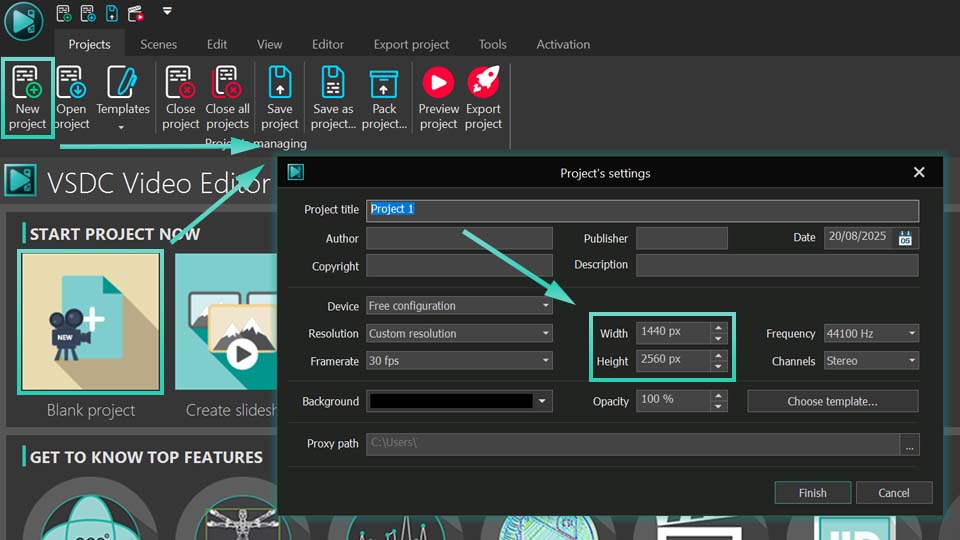 A guide to inputting the exact height and width for your project's dimensions
Next, use the Free Shape tool to create the background. Make sure the shape covers the entire scene. If you’re using VSDC version 10.1 or later, you can access the built-in gallery of premade shapes. Just left-click the Free Shape option, select "From gallery" and pick a shape that fits your design: in this case, we’ll use the square and stretch it to fill the scene completely.
To apply a point gradient to your shape, click it on the timeline to access its settings in the Properties window. Locate the Brush option and set it to "Point gradient".
After that double-click your free shape on the timeline to reveal its control points. These points will determine the gradient distribution. Select the first point, then go to the Properties window of the selected point. Enable "Brush gradient settings" and adjust the color as needed. Repeat this process for each point.
Preparing to select colors for a custom gradient background by enabling the correct mode.
In our example the free shape consists of four main points, so the gradient is based on four colors. If you need a smoother or more complex gradient with additional colors, you’ll need to create more points when initially designing the free shape.
If you notice that a certain color appears too bright or not bright enough, you can adjust it by selecting the corresponding point in the properties and modifying the "Weight" parameter to achieve the desired look.
Choosing your palette and using the Weight parameter to control color blending
Now that your gradient image is ready, it’s time to save it! Head over to the Editor tab and locate the green circle with a wrench icon (the repair tool), then select "Create a snapshot". Instantly, your image will appear in the Resources window, from where you can export it by right-clicking on it and choosing the corresponding option. Once saved, transfer it to your phone and set it as a wallpaper.
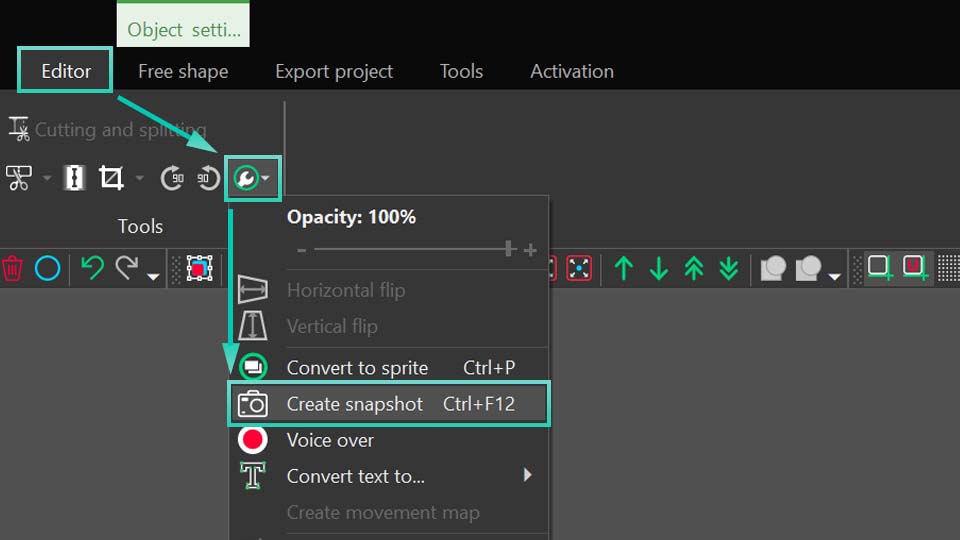 Using the snapshot tool to create a still image of your gradient design
Of course, such images can be created not just for smartphones, but for a wide range of other purposes as well.
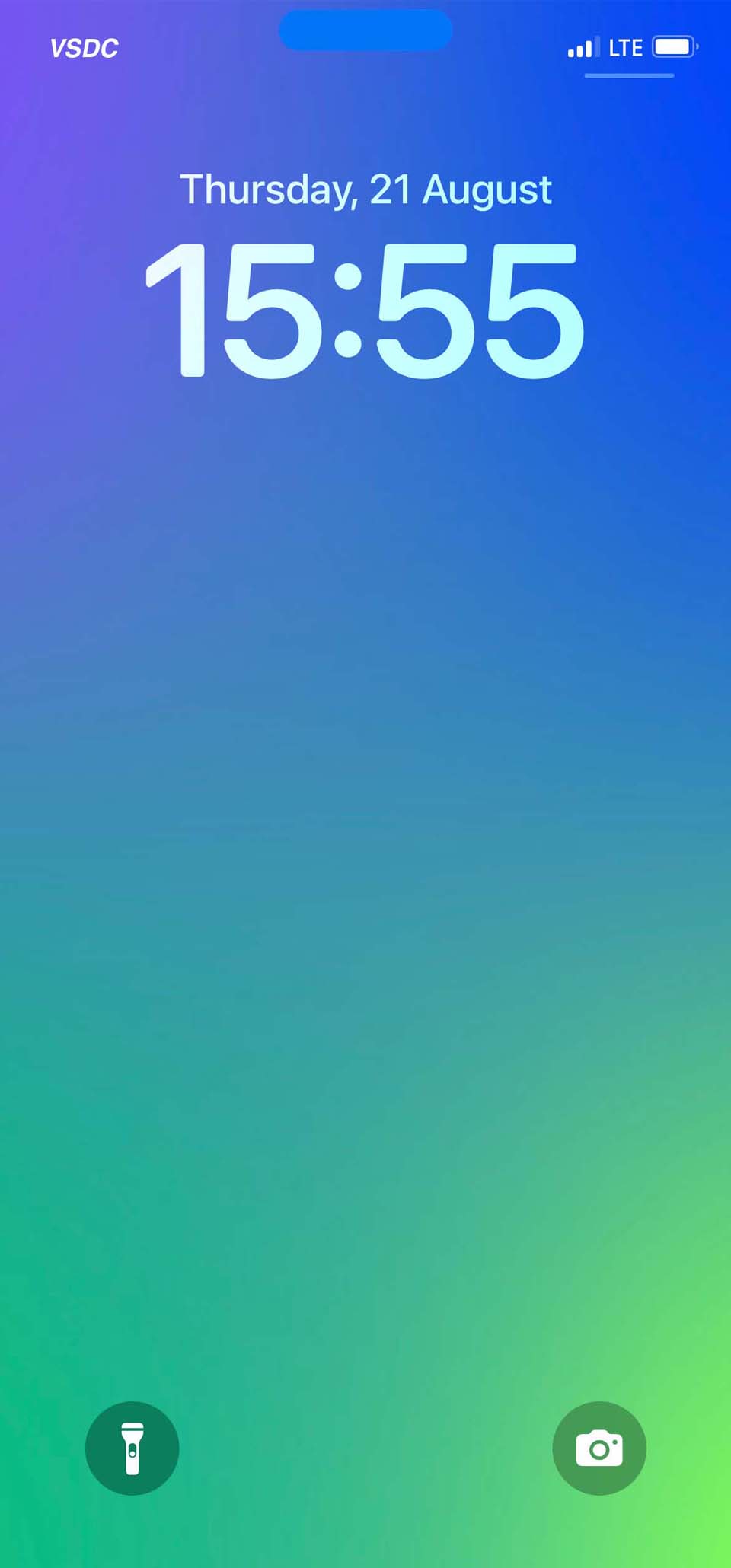
Displaying the final static background as it appears on a mobile device
Make Your Images Dynamic Using Color Keyframes (PRO)
If you upgrade to the PRO version, you can enhance your image with dynamic effects. To achieve this, we'll need to define keyframes and assign specific color values to them. Let's create an animated gradient where each corner of the image cycles through a color sequence.
For this project the initial colors are set as follows: the top right corner is blue, the top left is yellow, the bottom right is purple and the bottom left is green.
Activating the keyframe functionality to start animating color changes over time
Click on any Free Shape point on the timeline and locate the Color option. Click on the three dots in the corner of this setting to launch the Key Editor.
For easier workflow in the Key Editor, let's rename the "Color*" tab to "1" (which corresponds to the color this point has). We'll repeat this sequence for each of the four points we have on the timeline. Since there are four points in total, you should end up with four tabs in the Key Editor.
Renaming and organizing editor tabs for a more efficient animation process
For each of these points, we’ll set three keyframes. Please keep in mind that the display time for the first keyframe is the same across all points: the second keyframe shares another uniform timing, and so on.
Take the point we named with number one as an example. For us it is a blur color. Let’s move the cursor to approximately the 2.5-second mark and click the diamond icon to add a keyframe in the Key Editor. Repeat the same steps for the 5-second and 7.5-second marks.
By default, all newly added keyframes for a given point retain the original color value assigned to that point (for us it is blue). The same process applies to the remaining points of the free shape.
Now let’s set the colors for each keyframe. Go to the tab 1 in the Key Editor, find the second keyframe, double-click it and choose, for example, yellow color. We’ll set the colors for keyframe in each tab like that:
The top-right corner (blue): blue → yellow → green → purple → blue. The top-left corner point (yellow): yellow → green → purple → blue → yellow. The bottom-right corner point (purple): purple → blue → yellow → green → purple. The bottom-left corner point (green): green → purple → blue → yellow → green.
The Key Editor adjusts the position of each point based on your chosen color, allowing you to alter the shade or even the color itself by simply moving the point, though the final result ultimately comes down to personal preference.
Adding and manipulating color keyframes to create dynamic motion
Click the Play option and see the result! So nice, isn’t it?
The final result of smoothly transitioning colors in a dynamic background
If you want it to be more eye-catching, you can easily spice it up with the tracking point feature. Go to Scene 0 and double-click on the timeline. Locate the “Add tracking point” option in the Objects toolbar, click on it and position it anywhere in the preview window.
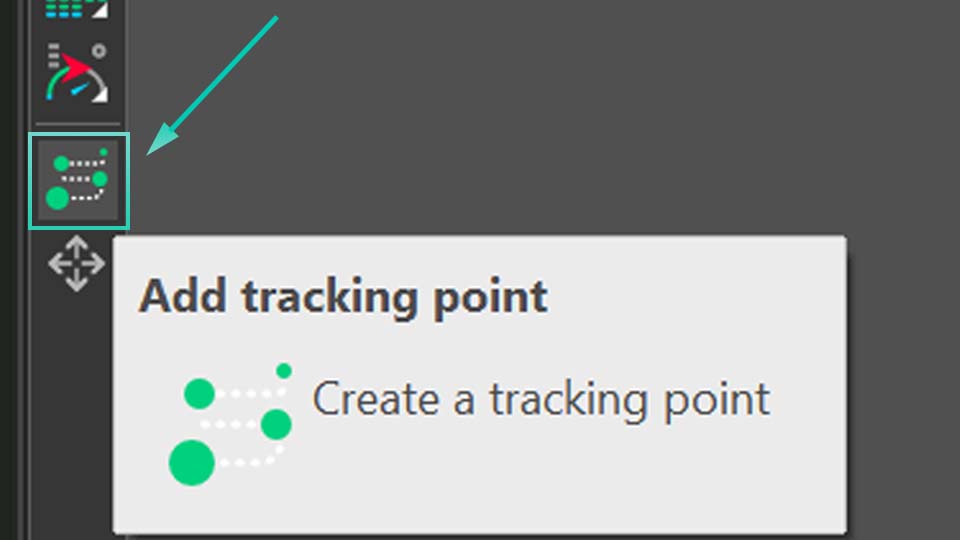
Using the add tracking point tool to attach and animate a light source
In the Properties window enable the Brush gradient settings and set the color value for the future running light, adjust its opacity and weight to your desire.
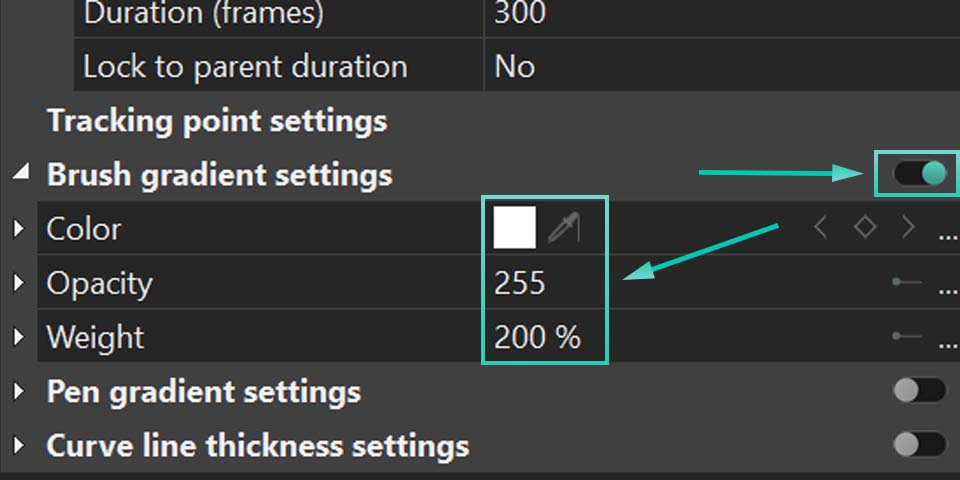
Adjusting the Brush tool's Color, Opacity and Weight to design light streaks
After that you’ll need just to set the trajectory that your running light will follow. For that double-click your tracking point on the timeline and choose another tool from the Objects toolbar: Movement. Click this tool and choose the place where the running light should come by clicking on this place on the scene. If you want to continue the trajectory, choose the point you’ve just added, click the movement tool again and add another point. You can create as many trajectories as you wish. If you want to learn more about the Movement tool, please read this article.
And that’s the result, just an example of what can be done using VSDC!
Showcasing the completed effect with flowing colors and a moving light trail
Explore more VSDC tutorials and unlock the full potential of your creativity. If you have any questions, we are always happy to hear from you at This email address is being protected from spambots. You need JavaScript enabled to view it..
Don’t forget to watch our video tutorials on YouTube and follow us on other social media.
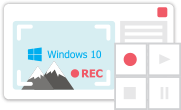
This program allows you to capture the video of your desktop and save it on your PC in various formats. Coupled with a video editor, the program is a great tool for creating presentations, tutorials and demo videos.

The program captures video from external devices and records it to computer in a free format. You can save video from video tuners, webcams, capture cards and other gadgets.
VSDC Video Editor Reviews & Ratings (Trustpilot, Capterra & Media)
VSDC Free Video Editor is rated 4.5/5 by real users on Trustpilot and Capterra. Here are a few reviews and quotes from creators and tech media.
Overall rating: 4.5/5 based on 200+ reviews on Trustpilot and 89 reviews on Capterra.
★★★★⯪
VSDC Free Video Editor is the best free video editor for Windows I’ve used, from color grading to picture-in-picture and cinematic results.
— Ejikeme Eloka Augustine
Source:Trustpilot
★★★★☆
Easy-to-use interface and quick export to social media make VSDC a versatile video editing tool for everyday projects.
— Karen C., E-Learning
Source:Capterra
★★★★☆
A feature-packed non-linear video editor for Windows that can compete with many paid video editing solutions.
— TechRadar
Source:TechRadar review
★★★★★
The free VSDC editor saved my YouTube channel – a powerful video editing software for chroma key, text effects and picture-in-picture.
— Paul Roberts
Source:Trustpilot
★★★★★
Fast and simple for YouTube videos with green screen, zoom, color tools and creative effects in one app.
— Marie R., Media Production
Source:Capterra
★★★★★
One of the best free video editor options for Windows users, ideal for GoPro, YouTube and family videos.
— VidProMom, YouTube creator
Source:Media reviews
★★★★★
I’ve been using VSDC for years; editing is easy and the final videos look great for my personal and professional projects.
— Long-time VSDC user
Source:Trustpilot
★★★★★
Great value and faster than many other free tools; I quickly create videos for YouTube, Instagram and Facebook with features my audience loves.
— Rabika B., Marketing & Advertising
Source:Capterra
★★★★★
VSDC offers many features you don’t usually find in free editors, including picture-in-picture, stabilization and modern codec support with no watermarks.
— Tech media review
Source:Media reviews
 Like us on Facebook
 Follow us on Twitter
Watch us on YouTube
 / @VSDCFreeVideoEditor
© 2011-2026, www.videosoftdev.com, FLASH-INTEGRO LLC. Privacy policy | Terms of use | About us
All trademarks referenced herein are the sole property of their respective owners.
Copying any materials from this site allowed only with written consent of Site Administration.