 User Help Manual
  Learn FAQ
  Send us feedback


How to Edit Multi-Camera Videos in VSDC | Multicam Guide
VSDC Multicam gives video creators a professional workflow for synchronizing footage from multiple cameras, switching angles during playback, and managing video and audio from one editing workspace. It is ideal for interviews, podcasts, live events, performances, tutorials, product demonstrations, and any project recorded from several viewpoints.
With VSDC Free Video Editor, you can create a multicam clip from two camera angles, synchronize the sources by sound or timecode, choose a master audio track, switch between shots in real time, and export the finished video without a watermark. Projects that require three or more camera angles can be edited in VSDC Pro.
Watch the video tutorial below, then follow the complete step-by-step guide to create your own multi-camera video in VSDC.
 DOWNLOAD VSDC FREE VIDEO EDITOR
Before you start: prepare your multicam footage
A few simple preparation steps will make synchronization faster and angle switching more precise:
- Import every camera recording and any separate microphone or audio-recorder track you plan to use
- Choose the cleanest recording as the master audio track for the finished video
- Use a synchronization clap, spoken cue, music, or another clear common sound when recording
- Give the camera files clear names so that every angle is easy to identify
- Check smartphone footage for orientation and variable frame-rate differences before editing
- For demanding 4K or high-bitrate footage, generate proxy media in the Resources window to keep preview and angle switching smooth
VSDC uses the original source files during export, so working with proxy media improves editing performance without reducing the quality of the final video.
Step 1. Import the camera and audio files
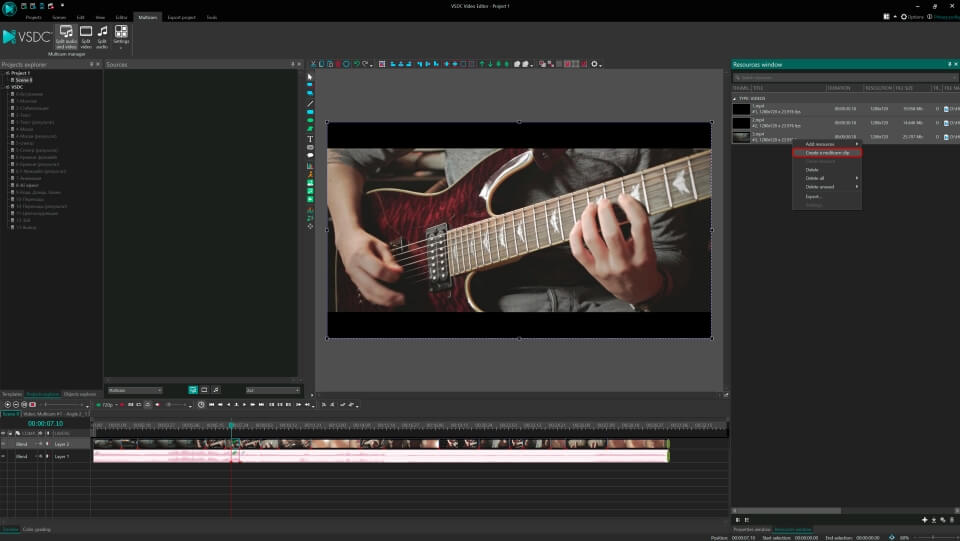
Open the Resources window on the right. If it is hidden, go to the View tab, select Resources, and click View/Hide window. Drag the camera files and audio recordings from your computer into the Resources window.
Select all sources you want to include, right-click the selection, and choose Create a multicam clip. VSDC will open the multicam settings, where you can choose the synchronization method, camera naming system, and default audio track.
Step 2. Synchronize and configure the multicam clip
The multicam settings window brings the essential preparation tools together in one place. Configure the synchronization mode, camera names, and master audio track before adding the clip to the timeline.
Choose a synchronization mode
VSDC provides four synchronization methods, allowing you to match camera recordings according to the way the project was captured.
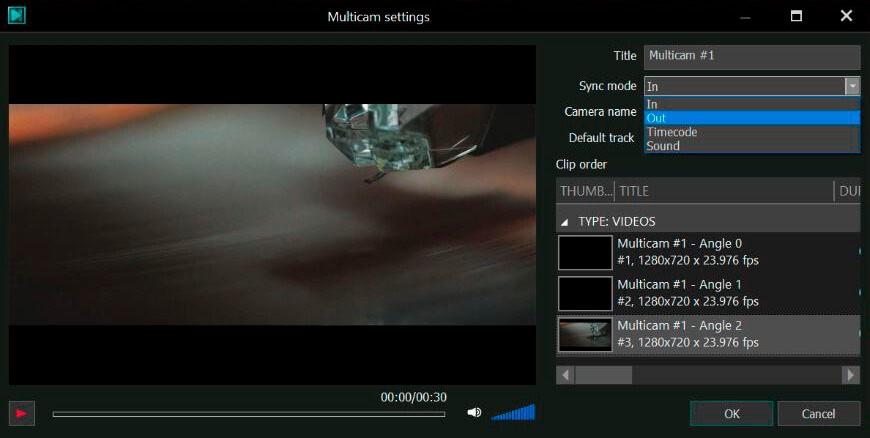
- In — aligns the clips by their starting points
- Out — aligns the clips by their ending points
- Timecode — synchronizes footage using the timecode stored in the source files
- Sound — analyzes the audio tracks and aligns matching sound automatically
For interviews, concerts, presentations, and events where every camera recorded the same audio, Sound mode is usually the most convenient choice. VSDC analyzes the shared audio and aligns the recordings automatically.
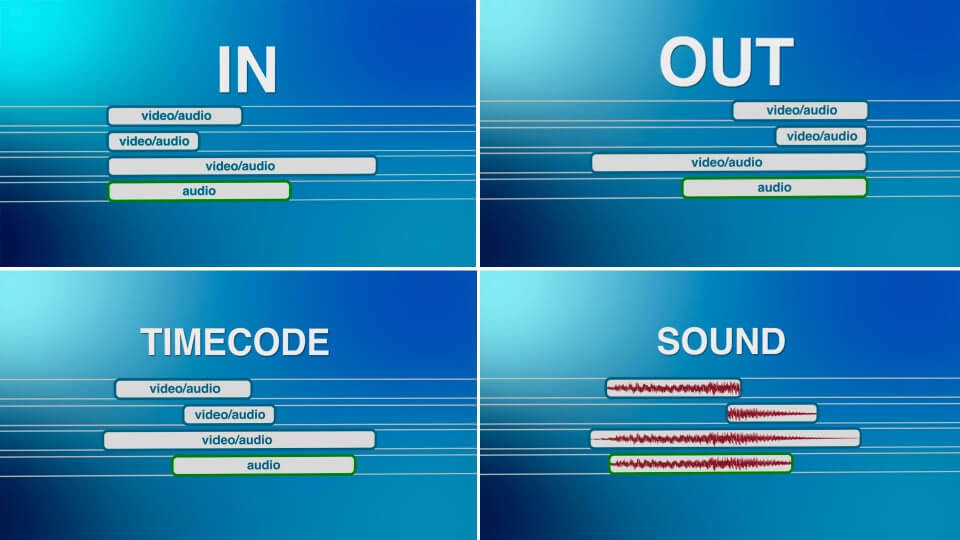
If the cameras were recorded with matching timecode, choose Timecode for a metadata-based professional workflow. Use In or Out when the recordings have a reliable common starting or ending point.
Name the camera angles
The Camera name setting determines how the sources are labeled in the Multicam panel. You can use sequential numbers, angle names, camera metadata, or another available naming method.
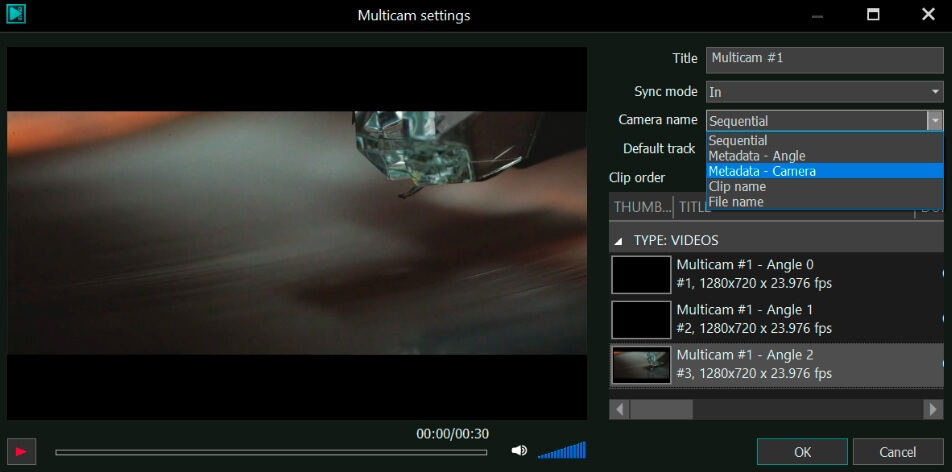
Clear names such as Wide shot, Speaker close-up, or Camera 2 make it easier to recognize each angle while editing, especially when several recordings show similar scenes.
Select the default audio track
Use the Default track menu to choose the main audio source for the multicam clip.
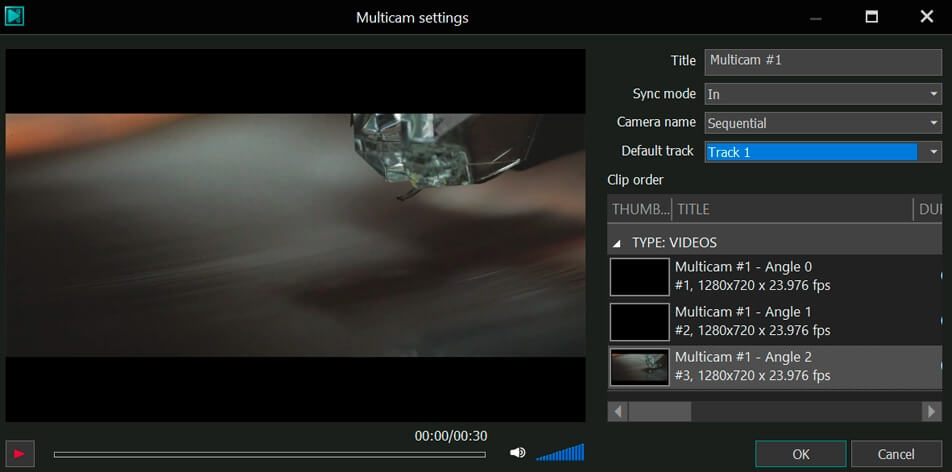
For a polished result, select the cleanest and most consistent recording. This may be the audio from a dedicated microphone, an external recorder, or the main camera. You can keep this master track playing continuously while switching only the video angles.
When the settings are ready, click OK. VSDC will create the synchronized multicam clip and add it to the Resources window.
Step 3. Add the multicam clip to the timeline
Find the newly created multicam clip in the Resources window and drag it onto the timeline.
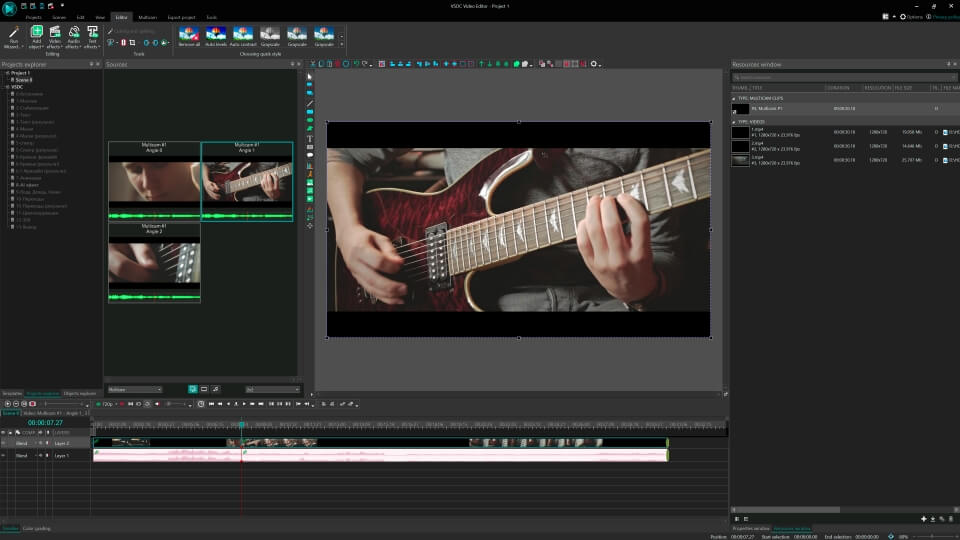
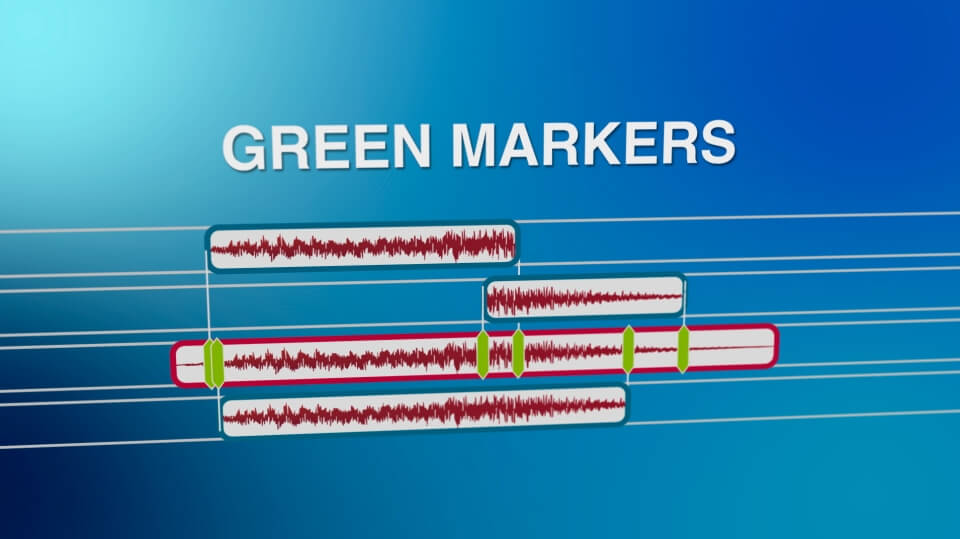
The multicam clip appears as a single, easy-to-manage object containing all selected camera and audio sources. Green markers indicate the boundaries of the source recordings and help you see where each file begins and ends.
This compact timeline design keeps the project organized while the dedicated Multicam workspace gives you direct access to every camera angle and audio source.
Step 4. Switch camera angles and control the audio
Open the View tab and select Sources. At the bottom of the Sources window, switch the workspace from Source to Multicam. The panel will display all camera angles and audio files included in the selected multicam clip.
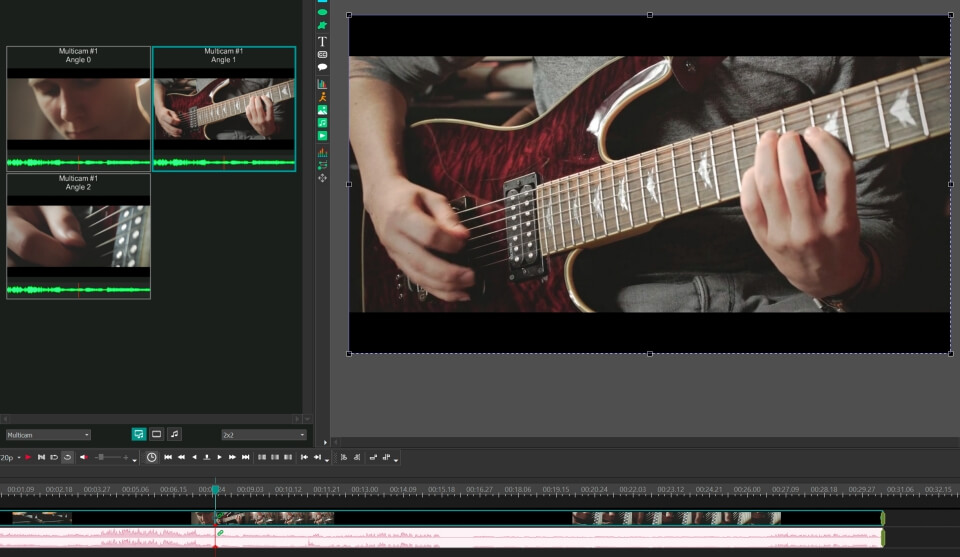
To change the active angle, click the required camera in the Multicam panel. You can switch shots while the video is playing to build the edit in real time, or pause playback and select angles with frame-level precision.
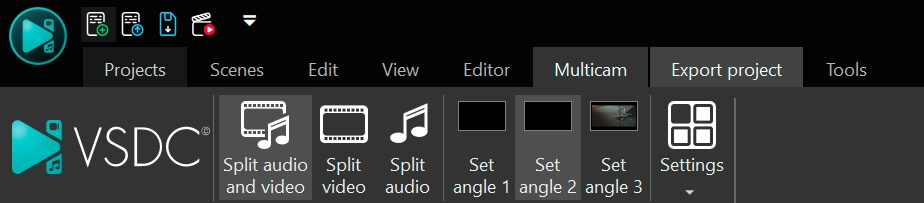
VSDC provides three editing modes for controlling how each selection affects the video and audio:
- Split audio and video — switches both the picture and the corresponding audio source
- Split video — changes the camera angle while preserving the current master audio track
- Split audio — changes the audio source without switching the active video angle

For interviews, podcasts, and performances, Split video is often the best option because it lets you switch camera angles while keeping one clean audio track uninterrupted. Use Split audio and video when each angle should bring its own sound, or Split audio when you need to replace only the audio source.
The same controls are available on the Multicam toolbar, so you can use the panel or the ribbon controls according to your preferred editing workflow.
Step 5. Refine and export the multicam video
After selecting the camera angles, use the standard VSDC editing tools to polish the project. You can trim unwanted sections, adjust colors, improve the audio, add titles, transitions, captions, logos, and visual effects, and fine-tune the timing directly on the timeline.
To export the finished multicam video, open the Export Project tab. Choose PC or Web as the target device, select MP4 or another required output format, and choose a profile that matches the resolution and frame rate of your project.
Use Edit profile when you need detailed control over the codec, resolution, frame rate, bitrate, and audio parameters. Then click Export Project to render the video. VSDC Free and VSDC Pro export without adding a watermark to the finished file.
For a complete explanation of the available formats and profiles, see the VSDC project export guide.
Why use VSDC for multicam video editing?
VSDC combines multi-camera synchronization, real-time angle switching, flexible audio control, proxy editing, professional effects, and watermark-free export in one non-linear video editor for Windows. The workflow is suitable for beginners who are creating their first two-camera interview as well as experienced creators producing complex event, podcast, performance, and tutorial videos.
VSDC Free Video Editor supports multicam projects with up to two camera angles. When your production requires three or more angles, VSDC Pro expands the multicam workflow while providing additional professional editing and performance tools.
Frequently Asked Questions
1. How many camera angles can I use in VSDC Multicam?
VSDC Free Video Editor supports multicam projects with up to two camera angles. VSDC Pro removes this two-angle limit, making it the right choice for productions that use three or more cameras.
2. How do I synchronize multiple cameras by audio in VSDC?
Select Sound as the synchronization mode when creating the multicam clip. VSDC analyzes the audio recorded by each source and aligns matching sections automatically. For the best result, make sure every camera captured a clear common sound such as speech, music, or a synchronization clap.
3. How do I display both video and audio when switching camera angles?
Open the Sources panel, switch it to Multicam mode, and select Split audio and video. This mode updates both the active camera angle and its audio. Use Split video when you want to keep one continuous master audio track while changing only the picture.
4. Can I combine smartphone and camera footage in a VSDC multicam project?
Yes. VSDC can combine footage recorded with smartphones, cameras, action cameras, and external audio recorders in the same multicam project. Before creating the clip, check the orientation, frame rate, resolution, and audio quality of each source for the smoothest workflow.
5. How do I open the Multicam preview panel in VSDC?
Open the View tab and select Sources. At the bottom of the Sources window, switch the workspace from Source to Multicam. The panel will display the camera angles and audio sources included in the selected multicam clip.
Ready to create a professional multi-camera video? Download VSDC Free Video Editor and start editing synchronized camera angles today. For product questions, email us at This email address is being protected from spambots. You need JavaScript enabled to view it. or send us a message through Facebook.
Get VSDC Free Video Editor — professional non-linear video editing software for Windows with multicam synchronization, real-time angle switching, flexible audio control, proxy editing, and watermark-free export. Explore all features.
 Like us on Facebook
 Follow us on Twitter
Watch us on YouTube
 / @VSDCFreeVideoEditor
© 2011-2026, www.videosoftdev.com, FLASH-INTEGRO LLC. Privacy policy | Terms of use | About us
All trademarks referenced herein are the sole property of their respective owners.
Copying any materials from this site allowed only with written consent of Site Administration.